



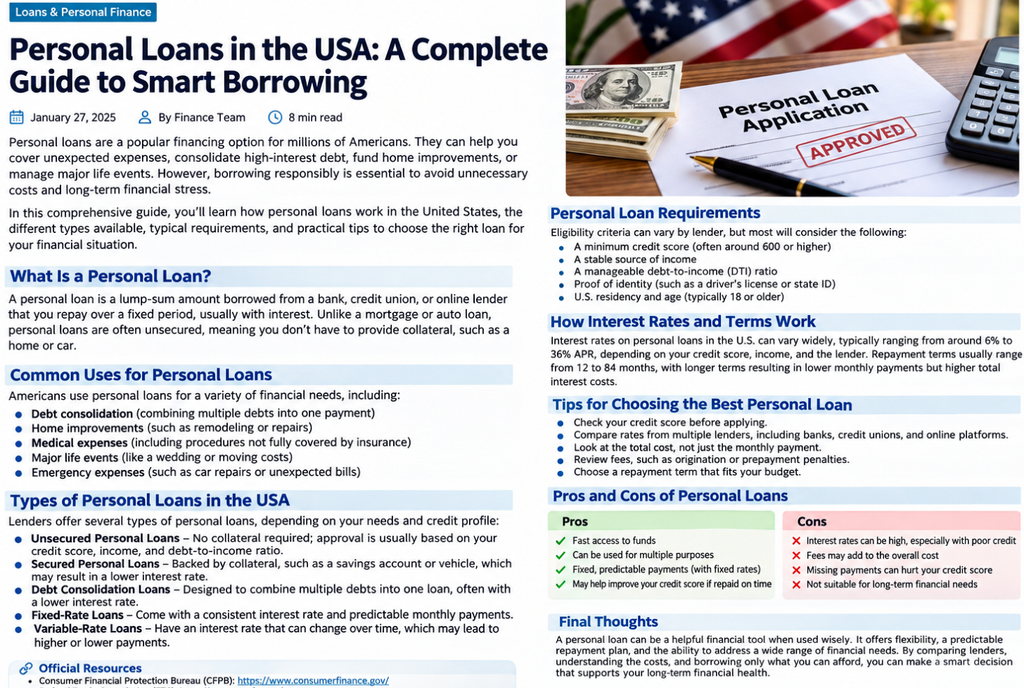
Personal loans have become an important financial tool for Americans looking to manage unexpected expenses, consolidate debt, renovate their homes, or finance major purchases. With banks, credit unions, and online lenders offering different financing options, understanding how personal loans work is essential to making informed financial decisions.
Choosing the right personal loan involves more than finding the lowest monthly payment. Borrowers should carefully evaluate interest rates, repayment terms, additional fees, and their overall financial situation before signing a loan agreement.
What Is a Personal Loan?
A personal loan is a type of installment financing that allows individuals to borrow a specific amount of money and repay it through scheduled payments over an agreed period.
Unlike mortgages or auto loans, personal loans can generally be used for a variety of financial needs, subject to lender restrictions.
Common uses include:
- Credit card debt consolidation
- Home improvement projects
- Medical expenses
- Emergency financial needs
- Moving and relocation expenses
- Major household purchases
Most personal loans have fixed interest rates, making monthly payments more predictable and easier to incorporate into a household budget.
Types of Personal Loans Available in the USA
American borrowers can choose from several types of personal loans depending on their financial circumstances.
Unsecured Personal Loans
Unsecured personal loans do not require borrowers to provide collateral. Lenders typically evaluate credit history, income, employment information, and existing financial obligations.
These loans may be suitable for individuals who do not want to pledge personal assets.
Secured Personal Loans
Secured personal loans require collateral, such as a savings account or another eligible asset. Because collateral reduces the lender’s potential risk, these loans may offer more favorable borrowing terms.
However, borrowers could lose their collateral if they fail to meet repayment obligations.
Debt Consolidation Loans
Debt consolidation loans allow borrowers to combine multiple eligible debts into a single loan. This approach may simplify monthly payments and potentially reduce overall interest costs when the new loan offers better terms.
Borrowers should compare the total repayment cost before consolidating existing debt.
How Personal Loan Interest Rates Work
Interest rates represent the cost of borrowing money. Personal loan rates vary depending on several factors, including creditworthiness, income, loan amount, repayment period, and lender policies.
The annual percentage rate, commonly known as APR, provides a broader measure of borrowing costs because it includes interest and certain applicable fees.
For example, a hypothetical $10,000 personal loan with a 36-month repayment period and a fixed annual interest rate of 10%, assuming no additional fees, would have approximately the following costs:
| Loan Details | Amount |
|---|---|
| Loan Amount | $10,000 |
| Interest Rate | 10% |
| Repayment Period | 36 months |
| Monthly Payment | $322.67 |
| Total Interest | $1,616.19 |
| Total Repayment | $11,616.19 |
This example is illustrative and does not represent an actual lender offer.
Personal Loan Eligibility Requirements
Although requirements vary between financial institutions, lenders commonly consider factors such as credit history, income stability, existing debt, and the applicant’s ability to repay.
Applicants may also need to provide identification, proof of income, and residential address information.
A healthy credit profile can improve access to competitive financing options. However, approval and interest rates are never guaranteed based solely on a credit score.
Some lenders offer prequalification, allowing consumers to review potential loan offers without an initial hard credit inquiry. Borrowers should confirm how the lender handles credit checks before applying.
Where to Apply for Personal Loans
Consumers in the United States can explore several lending sources:
Traditional banks: Established financial institutions may offer personal loans through physical branches and online banking platforms.
Credit unions: Member-owned financial institutions may provide competitive borrowing rates and personalized customer service.
Online lenders: Digital lending platforms often provide convenient applications, electronic documentation, and streamlined approval processes.
Comparing multiple providers can help borrowers identify financing options that align with their individual circumstances.
How to Find an Affordable Personal Loan
Finding an affordable personal loan requires careful research. Borrowers should compare annual percentage rates, origination fees, repayment periods, late payment charges, and potential prepayment penalties.
Choosing a shorter repayment period may reduce total interest expenses, although monthly payments will generally be higher.
Longer repayment periods may provide lower monthly payments but could increase the total cost of borrowing.
Consumers should also verify that a lender is legitimate before providing sensitive personal or financial information.
Common Personal Loan Mistakes to Avoid
Borrowing more money than necessary can create unnecessary financial pressure. Similarly, selecting a loan based exclusively on monthly payments may result in higher long-term costs.
Borrowers should avoid lenders that make unrealistic approval promises, demand suspicious upfront payments, or fail to clearly disclose loan terms.
Reading the complete loan agreement and understanding repayment obligations can help prevent unexpected financial difficulties.
Conclusion
Personal loans can provide valuable financial flexibility when used responsibly. Whether the goal is debt consolidation, home improvement, or managing unexpected expenses, selecting an appropriate loan requires careful consideration.
Leave a Reply